

BracesOrthodontics
Lake Forest, IL – If you are exploring orthodontic treatment options, you have likely heard the name “Damon.” Whether it is Damon Braces, Damon Clear, or other self-ligating systems, you might have encountered them during a consultation or seen promotional material on a practice’s website that claims 30 percent shorter treatment times, fewer appointments, no extractions, and/or less pain.
These claims are certainly appealing, but they raise a valid question: if a specific bracket system could truly deliver all these results, wouldn’t every orthodontist in Lake Forest and beyond already be using it?
Let’s take a closer look at what these appliances actually are, what the research says, and what factors truly shorten orthodontic treatment times.
What are self-ligating braces?
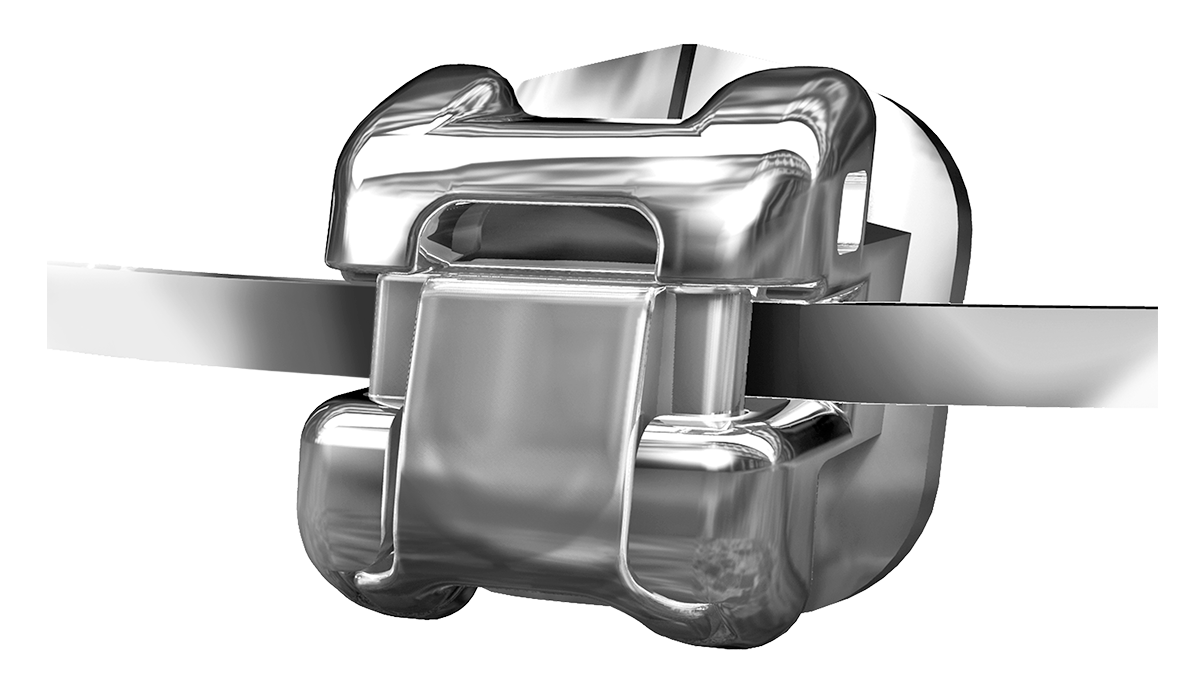
Damon braces are a brand of self-ligating braces, not a separate category of orthodontic treatment. Like traditional metal or ceramic braces, they consist of brackets and an archwire; the only real difference lies in how the archwire is secured.
Traditional braces use ligatures, tiny rubber bands or thin metal wires, to hold the archwire in place against each bracket. Self-ligating brackets eliminate the need for these ligatures, replacing them with built-in clips or sliding doors.
That is it. That is the extent of the “innovation.”
The theory is that reducing friction between the archwire and the bracket allows teeth to move more freely. Before diving deeper, one point is worth clarifying: self-ligating braces are not a recent innovation; self-ligating brackets have been used since the 1970s. Since then, they have been repackaged and marketed repeatedly, and the heavily funded marketing push has created the illusion of a brand-new product.
Do they really speed up tooth movement?
This is the core marketing claim for this type of product, yet it is precisely the point least supported by evidence.
Randomized controlled trials (RCTs), considered the gold standard, have compared self-ligating bracket systems with traditional brackets. Studies published in the American Journal of Orthodontics and Dentofacial Orthopedics and The Angle Orthodontist, as well as independent trials from the UK, all point to the same conclusion: there is no clinically significant difference between the two systems regarding the rate of tooth movement. One study even found that the speed of the initial alignment phase was slightly slower when using self-ligating brackets.
The American Association of Orthodontists has also reviewed the relevant literature and has affirmed that, currently, there is no reliable evidence indicating that self-ligating brackets shorten orthodontic treatment time.
“When you strip away the marketing hype, the difference comes down to two different methods of securing the archwire in the bracket slot,” says Dr. Stosich, a board-certified orthodontist and Director of Orthodontics at the University of Chicago. “What really matters is the diagnosis and the treatment plan. Replacing elastic bands with a clip mechanism does not alter the biological process of bone remodeling around the teeth.”
In the UK, the national advertising regulator reviewed evidence submitted by manufacturers and found it insufficient to support claims of “faster tooth movement” or “reduced pain.” Dr. Kevin O’Brien, a professor of orthodontics at the University of Manchester, has written a detailed analysis of this case. It serves as a lesson for any practice engaging in advertising: your claims must withstand independent scrutiny.
So, will there be fewer follow-up visits?
Individual adjustment appointments for Damon and other self-ligating braces may indeed be slightly shorter. Opening and closing a clip is faster than removing and replacing a dozen or more elastic bands; for parents squeezing in an appointment before school pickup, saving a few minutes can be significant.
However, research does not support the broader claim that Damon or other self-ligating braces reduce the total number of visits over the course of treatment, or that treatment will finish months earlier. The frequency of a patient’s follow-up or adjustment visits depends on the rate of bone remodeling around the tooth roots. This is a biological process that no brand or type of bracket can accelerate.
Can they help me avoid extractions or the use of an expander?
This question requires the most careful answer, as such claims are the most likely to mislead families into choosing the wrong treatment plan.
The answer is no: a single bracket system cannot determine whether tooth extraction is needed or not. That decision comes out of a careful diagnostic workup that weighs different interplaying factors, including:
- The ratio of tooth size to jaw size. Can the existing teeth fit within the available jaw space without being pushed into a position where stability cannot be maintained?
- Facial and skeletal proportions. The position of the front teeth relative to the lips, facial profile, and jaw structure determines how much space can be safely created.
- Long-term stability. If teeth are moved outside the boundaries of their supporting bone, they tend to relapse, potentially putting gum tissue at risk in the process.
The good news for most families is that more than 90 percent of patients today are candidates for non-extraction treatment plans. This is due to more precise diagnostics, earlier intervention, and advancements in modern orthodontic technology, rather than any specific brand of brackets.
Of course, in some cases, extraction remains the healthiest and most reliable option, but orthodontic systems marketed as extraction-free cannot change this fact; they only make the conversation with your family harder than it needs to be.
The same principle applies to arch expansion. Any type of appliance can achieve some degree of arch expansion, but this movement occurs within the limits of the patient’s existing jaw structure. If the upper jaw itself is narrow, a true skeletal deficiency, brackets alone cannot widen it. This requires a palatal expander, a device that gradually separates the growth suture in the roof of the mouth while a child is still growing.
This is one of the main reasons we recommend that children have their first orthodontic evaluation around age 7, well before all the permanent teeth have come in.
Are they more comfortable to wear?
The jury is still out on that. That is the honest truth, even if advertisements often suggest otherwise.
At least one randomized controlled trial found no difference in reported discomfort between patients using self-ligating brackets and those using traditional brackets. Regardless of the system used, soreness following an adjustment is normal; it is usually short-lived and well-tolerated by most patients.
Do Damon braces cost more or create a better smile?
Damon braces generally do not cost more than other types of braces. Treatment costs vary by practice and by the complexity of a patient’s case.
The more important question is whether the treatment approach is tailored to you. Damon marketing promotes the term “Damon smile” to describe a broad-arch smile that shows more teeth and reduces the dark spaces at the corners of the mouth. Damon’s website says that the Damon System “gives you a broader smile than conventional braces.”
Although this marketing promotes a particular type of smile, the bracket system used should not define the desired outcome. The appropriate result depends on each patient’s unique anatomy, needs, and treatment goals.
Dr. Stosich’s goal is not to give every patient a generic smile, but to design one based on the patient’s individual orthodontic profile and tailored to their facial proportions and tooth and jaw relationships while promoting the long-term stability of the results.
“The appliance is merely a tool,” says Dr. Stosich. “What matters more is who is using it: the rigor with which the doctor diagnoses the case and formulates the treatment plan, and how they respond when tooth movement doesn’t go exactly by the textbook. That is what you are truly paying for.”
So, what exactly is it that shortens the treatment time?
“Precise diagnosis and treatment planning,” says Dr. Stosich. “Determining the final position of every tooth before the first bracket is even bonded, and mapping out the steps to achieve that goal, so that no movement is wasted.”
And, of course, the patient’s cooperation: wearing elastics as instructed, attending appointments on time, and wearing retainers faithfully and consistently after the braces come off.
When evaluating an orthodontist, look beyond the brand names of the appliances listed on a website and get to know the doctor:
- Training. Are they a board-certified specialist with university-based specialty training? Do they use evidence-based methods for diagnosis and treatment?
- Planning. Do they thoroughly show and explain to you the diagnostic records, the treatment plan, the goal and expected outcomes before you commit or sign any paperwork?
- Listening. Do they truly understand your concerns about your smile, rather than focusing solely on what shows up on the X-rays?
- Honesty. Are they upfront about when a treatment isn’t necessary or when a trendy procedure lacks scientific backing?
- Results. What do their past and existing patients say? Can they show you completed cases like yours?
Before committing to a treatment, do your homework: look up the orthodontist’s credentials, training, and professional achievements, read their online reviews, and look for a before-after gallery on their website.
How can Deerpath Orthodontics and Family Dental help you?
At Deerpath Orthodontics and Family Dental, Dr. Michael Stosich and his team provide families in the Lake Forest area with science-based advice rather than sales pitches. “As a board-certified orthodontist committed to the highest standards of care, I prioritize treatment plans backed by solid scientific evidence,” says Dr. Stosich. He brings over 15 years of exceptional clinical experience and serves as the Director of Orthodontics at the University of Chicago.
Deerpath also offers comprehensive general dentistry services led by Dr. Gerel Emgushova, all under one roof. That means your family’s oral health is watched by two sets of eyes at every stage of treatment.
Take the first step today
We won’t push trendy treatments on you. Instead, we’ll show you your diagnostic records, explain your treatment options, and be honest about what truly works and what isn’t necessary. Call us at 847-579-4979 to schedule your complimentary consultation.
References
Songra G, Clover M, Atack N, et al. Comparative assessment of alignment efficiency and space closure of active and passive self-ligating vs conventional appliances in adolescents: a single-center randomized controlled trial. Am J Orthod Dentofacial Orthop. 2014;145(5):569-578.
Pandis N, Polychronopoulou A, Eliades T. Self-ligating vs conventional brackets in the treatment of mandibular crowding: a prospective clinical trial of treatment duration and dental effects. Am J Orthod Dentofacial Orthop. 2007;132(2):208-215.
Wright N, Modarai F, Cobourne MT, DiBiase AT. Do you do Damon? What is the current evidence base underlying the philosophy of this appliance system? J Orthod. 2011;38(3):222-230.
Scott P, DiBiase AT, Sherriff M, Cobourne MT. Alignment efficiency of Damon3 self-ligating and conventional orthodontic bracket systems: a randomized clinical trial. Am J Orthod Dentofacial Orthop. 2008;134(4):470.e1-470.e8.
Atik E, Ciğer S. An assessment of conventional and self-ligating brackets in Class I maxillary constriction patients. Angle Orthod. 2014;84(4):615-622.
Vajaria R, BeGole E, Kusnoto B, Galang MT, Obrez A. Evaluation of incisor position and dental transverse dimensional changes using the Damon system. Angle Orthod. 2011;81(4):647-652.