
Orthodontics
Dr. Michael Stosich explains what to watch for if you suspect your child breathes through their mouth more than their nose.
Lake Forest, IL – Parents, you might have observed that your child mouth breathes during bedtime while they sleep, and their lips are kind of dry or cracked by the morning. That can even happen during the daytime. For example, when they are watching TV, you might notice that they never fully close their mouth, even when they are just sitting there. As parents, you might wonder: is this a big deal, or is it another habit they will outgrow by themselves?
Why does it matter whether my child breathes through their nose or mouth?
The simple answer is that the nose is not just there for smelling things. It filters, warms, and humidifies the air your child takes in, and it also plays a crucial role in how the face and jaw develop as your child grows. A recent 2026 study published in the journal Healthcare looked across the available prior research and found a consistent pattern in children who chronically breathe through their mouths. They were more likely to develop a narrow upper jaw (also known as a narrow palate), a high, vaulted palate, a longer, downward-growing facial pattern, and also crowded teeth.
Despite this finding, the researchers were careful about one thing: association is not the same as causation. Furthermore, the studies they reviewed did not always define breathing through the mouth the same way. Dr. Stosich practices evidence-based care and takes that seriously. He is not going to tell parents that one symptom means disaster or will lead to any of these outcomes in the future.
What are the signs of mouth breathing to watch for in children?
A few important patterns tend to show up together:
- An open-mouth resting posture during the day, even outside of a cold or a stuffy nose.
- Snoring, restless sleep, or sleeping with the neck extended and the head tipped back.
- Daytime tiredness, crankiness, or trouble focusing, which can happen when sleep is poor.
- Dry, cracked lips or a dry mouth first thing in the morning.
- Dark circles under the eyes, sometimes called “allergic shiners.”
- A gradually longer, narrower facial appearance developing over months or years, what’s sometimes called an “adenoid face.”
What actually causes a child to breathe through their mouth?
Most of the time it traces back to something physically blocking their nasal airflow. It could be enlarged tonsils or adenoids, chronic nasal allergies, or a deviated septum. Occasionally, it’s just a habit that stuck around after a cold cleared up, long after the congestion that started it was gone.
A pediatrician or ENT usually handles these causes. Dr. Stosich focuses on what chronic mouth breathing can leave behind, such as a narrow palate or crowded teeth.
Could mouth breathing already be affecting my child’s smile?
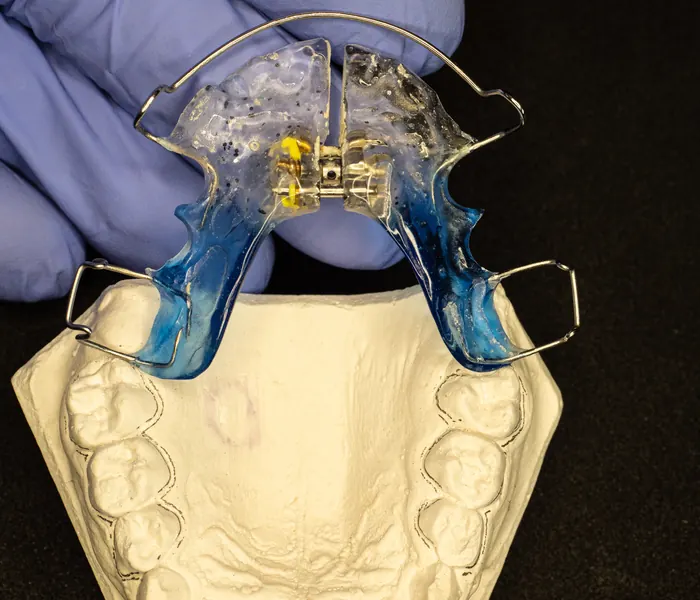
If the mouth breathing has been going on for a while and isn’t only happening during a cold, it’s worth a look by an orthodontic specialist. A narrow palate that develops from years of mouth breathing doesn’t always correct itself once the underlying cause is treated. The good news is that in a growing child, we can often fix this through growth guidance, which means guiding the width of the palate with a standard expander. In older teens whose palate suture is already maturing or fusing, Dr. Stosich will evaluate whether a custom palatal/molar-borne expander or a MARPE is better for your child. Either way, that’s why Dr. Stosich looks at the patient’s breathing patterns as part of his airway-focused orthodontic evaluation, in both children and adolescents.
“I’d rather see a family a year too early than a year too late,” says Dr. Stosich. “Not every child who breathes through their mouth during a cold needs treatment. A pattern that persists for months, especially alongside snoring or dental crowding, deserves an actual evaluation, not a guess.”
What should I do if I notice these signs?
Parents should start with their pediatrician or an ENT specialist to rule out or treat other underlying medical causes, such as allergies, enlarged tonsils, or something else. From there, the next step is an orthodontic screening. The American Association of Orthodontists recommends a first orthodontic evaluation by age 7, and a persistent mouth-breathing pattern is just another reason not to wait past that age. Dr. Stosich, as Director of Orthodontics at the University of Chicago, works alongside pediatric ENT specialists on exactly these cases, and Deerpath’s integrated general dentistry with Dr. Gerel Emgushova means any dental side effects get addressed at the same time.
Take the first step today
If your child’s mouth breathing has been on your mind for a while, don’t wait for it to resolve on its own. Call Deerpath Orthodontics and Family Dental at 847-579-4979 to schedule your complimentary consultation, and let’s find out what’s really going on.
References
Sotero Grande E, Checa-Caratachea XA, Cruz-Hervert LP, Castillo Salazar G, González-Aragón Pineda ÁE. Mouth Breathing and Craniofacial Development in Children: A Systematic Narrative Review and Clinical Implications. Healthcare (Basel). 2026;14(12):1737.